


It’s tempting to start a rollout where the excitement is: the creative. But the stores are what the creative has to fit, and they’re rarely as uniform as the store list makes them look.
So before anything gets sized, get real data on every door. That means window dimensions (measured, not pulled from a drawing from the last remodel), fixture counts, wall surfaces, and anything unusual, like the mall location with no storefront window or the store where the register moved last spring.
That data becomes your distribution list: the master record of which store gets which pieces, in which sizes, for which fixtures. It’s the most important document in the rollout, and it’s the one nobody wants to make. A good print partner will help you build it, and on a new program, will survey the stores that don’t have good data yet.
The art decides what the rollout looks like. The store list decides whether it fits.

Every rollout has one date that doesn’t care about anyone’s excuses: the day the campaign has to be live in stores. Everything else gets planned backward from it.
That’s a workback schedule, and it runs in reverse: in-store date, then install window, then ship date, then packing, production, proofing, and finally the day final art is due. Build it first, before the art exists, and make every date on it a real commitment on both sides.
Here’s the part most plans miss. Art approvals sometimes run late, because priorities shift and leadership weighs in, and that’s just how fast-moving retail works. The fix isn’t more padding in the schedule.
It’s a partner who reserves press time in advance and builds the prepress files (the print-ready templates for every size and piece) before final art lands. When the art does land, it’s plug it in and hit go. That’s how we shipped 623 packages to 89 stores for one of the nation’s most iconic retailers with seven calendar days between art approval and ship date.
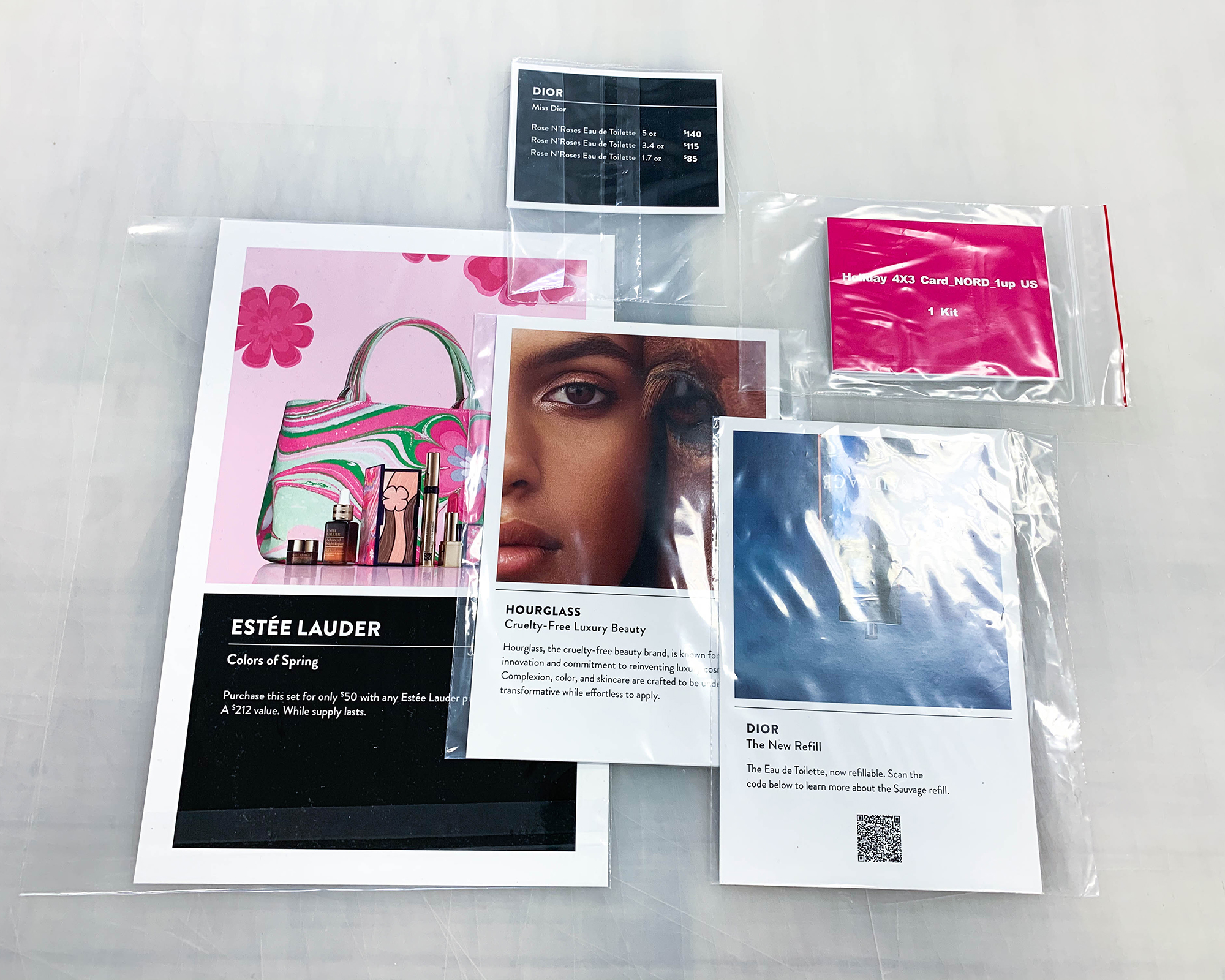
A kit is everything one store receives for the campaign: window graphics, fixture toppers, wall graphics, signage, and the small stuff like counter cards. One identical kit for every door sounds efficient. It usually isn’t.
Most national retail programs work better tiered. The flagship gets the full experience, core stores get a version built for their footprint, and the smaller or outlier doors get exactly what fits. Nobody should be unpacking a window graphic in a store without a window.
Tiering by store profile also keeps the distribution list manageable, because you’re matching stores to three or four kit versions instead of building 200 one-offs.
And if the program refreshes every season, plan hardware that stays. An SEG frame (a slim aluminum frame that holds a fabric graphic by a silicone strip sewn around its edge) stays on the wall, and next season’s graphic swaps in minutes. Next season’s rollout gets a lot lighter when half of it is already installed.

A rollout multiplies everything, including mistakes. A header card that’s a quarter inch too tall is a quirk in one store and a reprint in 200.
That’s why the plan needs a prototype stage. Anything structural or new, like a freestanding display or a fixture topper nobody has built before, should be built, tested, and put in front of your team before production starts.
On one recent program, we took floating staircase displays through several prototype rounds with the retailer’s team, and the first of 138 units shipped three weeks after final prototype approval.
Color gets the same treatment. Your brand red has to match on window film, fabric, and rigid board, in the flagship and in store #147, so ask for physical proofs on the actual materials instead of a PDF. (It’s why we’re G7 Expert certified, the industry’s benchmark for consistent color across machines and materials.)
A prototype is the one store where finding a problem is good news

The person opening the box on floor set morning has probably never seen the concept deck. They have a box cutter, a long to-do list, and maybe an hour before the doors open.
So the kit has to explain itself. Every piece should be labeled by store and location, every box should match the distribution list, and every kit should include a printed install guide (ours carry a QR code that links to the same guide online). Add a few spares of anything that scuffs easily, so one damaged header card doesn’t turn into a rush reprint.
Shipping deserves its own line in the plan, because big displays ship by dimensional weight: carriers charge for how much space a box takes up, not just what it weighs. On one of our previous rollouts, engineering a display to flat-pack into a standard carrier box instead of a crate saved the retailer more than $80K in shipping.
The best-packed kit is the one nobody has to call about.


Some pieces are easy for a store team, like a counter card, a fixture topper, or a fabric swap in an existing frame. Others aren’t, like a 12-foot window graphic that has to go up bubble-free before the mall opens. Decide which is which during planning, because it changes how every piece gets produced, packed, and scheduled.
Most national rollouts end up as a hybrid. Store teams handle the simple pieces, and professional installers take the windows, walls, and anything structural, in coordinated install windows built around store hours, mall rules, and the floor set itself.
What matters most is that one partner owns all of it. Our in-house Seattle crew and managed nationwide installer network run through the same team that printed and packed the job, so when a store calls with a damaged panel, the reprint is already moving before anyone has to figure out whose problem it is.


