THE WORLD’S BIGGEST SOCCER TOURNAMENT IS COMING TO SEATTLE. IS YOUR BRAND READY? We’ve built a ready-to-launch menu of customizable activations to help you turn foot traffic into revenue. EXPLORE THE GUIDE

Guinness World Record

Largest Digital Graphic

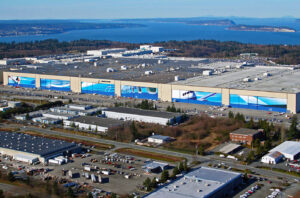
The largest digital graphic, produced by 3M and designed by SuperGraphics, measures over 929 m² (10,000 ft²) and has been featured on the six bay doors on the assembly building of The Boeing Company in Everett, Washington, USA since the 15 of February 2006. CD from The Boeing Company provided. The Boeing Company has applied a pressure-sensitive, adhesive-backed, digital graphic to its factory building in Everett, Washington. The mural gives the building an exciting look, one that attracts the eye of anyone. It’s a way to celebrate the people that are inside the factory and their passion for airplanes. The building, encompassing more than 98 acres and is recognized by Guinness World Records as the largest building in the world by volume. The mural has been applied to all six factory doors on the south side of the building, which range in size from 82 feet high by 300 feet wide to 82 feet high by 350 feet wide, each about the size of a National Football League (NFL) field. The doors have been measured by Boeing and by SuperGraphics, the company printing and applying all of the decals. The pressure-sensitive graphic film and other products were provided by 3M. The St. Paul, MN-based company pioneered the use of graphic films to wrap vehicles and buildings with promotional messages.

The film was digitally printed and installed by SuperGraphics, based in Seattle, Washington. Since 1993, SuperGraphics has used state-of-the-art design systems and electrostatic grand format ink jet and screen-printing technologies to create larger-than-life promotions that are impossible to miss. Each mural is distinct, but they carry through a common theme with lines rising and falling across all six.

Credit: Guinness World Records


Visit Guinness World Record

Share this story

latest

from our blog
Storefront exterior with curved metal roof featuring colorful gradient signage reading "Brooks Hyperion House," large window graphics with blue and white geometric elements, and entry doors.
Brooks Running takes ownership of its brand seriously — and Johnny Hubbard is a big reason why. As Creative Production Design Manager, he's spent 12 years building the production design infrastructure that translates Brooks' creative into every window, wall, and surface it lives on. Now, as Brooks opens its first owned retail stores, that foundation is exactly what's making it possible. Here's how it works.
Modular exhibit panels and display cases at the JCHS Museum of Art + History showing the Neighborhood Stories exhibit, with interchangeable reader rails and standardized graphic panels exploring Hoh River Valley, Chimacum, and Memorial Field.
A 132-year-old building. A modular exhibit system built like Legos. Graphics that get recycled at the local paper mill when the story cycle ends. Ellie DiPietro, Director of Research + Collections at the Jefferson County Historical Society, shares how her team reimagined the Museum of Art + History from the ground up — and why the smartest spaces aren't the most permanent. They're the ones designed to keep becoming something new.
Interior of the Bunnies By The Bay retail store designed by Clayton Marsh, featuring a coastal-themed environment with a dimensional lighthouse fixture, hand-illustrated wall murals of seabirds and fishing boats, white shelving displays filled with plush toys and gifts, and a painted mountain landscape mural above the merchandise.
With 28 years of experience designing for brands like Nike, Starbucks, and Columbia Sportswear, Clayton Marsh built his career at the intersection of creative and production. He shares why starting with materials, budgets, and installation logistics makes the work bolder — not safer.