THE WORLD’S BIGGEST SOCCER TOURNAMENT IS COMING TO SEATTLE. IS YOUR BRAND READY? We’ve built a ready-to-launch menu of customizable activations to help you turn foot traffic into revenue. EXPLORE THE GUIDE

Welcome to EcoFormat™!

For Immediate Release

PR@supergraphics.com
December 4, 2019


Seattle, WA – December 4, 2019   SuperGraphics is launching EcoFormat™, a groundbreaking business operations and recycling program starting January 1, 2020.

Large format printing is experiencing a technological revolution that is fueling growth and innovation. However, the industry has lagged behind other print segments in its adoption and application of eco-friendly business practices.

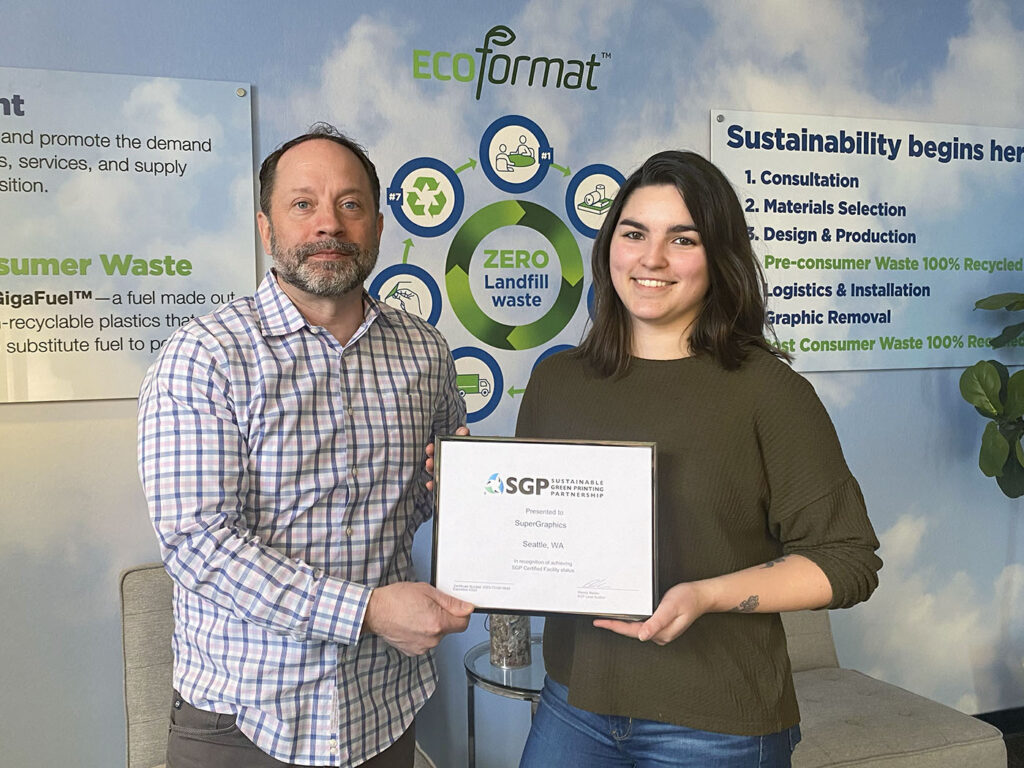
The ownership team at SuperGraphics believes it’s imperative to evolve its approach to environmental and community responsibility and have spent the last year assessing their operations from material choice to final waste disposition. EcoFormat™ incorporates its plan to address material and production waste company-wide from inside out and start to finish. This plan includes market and supply chain education, practical work and environment changes, and transformation of operational use and waste chain of custody.

“We are excited to launch EcoFormat™,” says SuperGraphics President, Reid Baker, “This is a new approach to managing pre and post-consumer waste. Nothing like this has ever been successfully executed in our industry, primarily because there hasn’t been the passion and creativity inserted into the waste logistics infrastructure. We aim to be successful by educating the marketplace, developing cost-neutral eco-friendly graphics, and disposing of all wastes in the most sustainable fashion available.”

EcoFormat™ will take the market to a new place by providing clients with “Landfill Neutral” (no landfill waste) large format graphics. Furthermore, SuperGraphics is striving to be PVC-Free by 2025.

SuperGraphics is a Seattle based large-format printer specializing in retail and environmental print solutions. They are a trusted partner to many iconic brands, who rely on our ability to execute local and nationwide programs, from concept to completion with superior results.


###
Share this story

latest

from our blog
Storefront exterior with curved metal roof featuring colorful gradient signage reading "Brooks Hyperion House," large window graphics with blue and white geometric elements, and entry doors.
Brooks Running takes ownership of its brand seriously — and Johnny Hubbard is a big reason why. As Creative Production Design Manager, he's spent 12 years building the production design infrastructure that translates Brooks' creative into every window, wall, and surface it lives on. Now, as Brooks opens its first owned retail stores, that foundation is exactly what's making it possible. Here's how it works.
Modular exhibit panels and display cases at the JCHS Museum of Art + History showing the Neighborhood Stories exhibit, with interchangeable reader rails and standardized graphic panels exploring Hoh River Valley, Chimacum, and Memorial Field.
A 132-year-old building. A modular exhibit system built like Legos. Graphics that get recycled at the local paper mill when the story cycle ends. Ellie DiPietro, Director of Research + Collections at the Jefferson County Historical Society, shares how her team reimagined the Museum of Art + History from the ground up — and why the smartest spaces aren't the most permanent. They're the ones designed to keep becoming something new.
Interior of the Bunnies By The Bay retail store designed by Clayton Marsh, featuring a coastal-themed environment with a dimensional lighthouse fixture, hand-illustrated wall murals of seabirds and fishing boats, white shelving displays filled with plush toys and gifts, and a painted mountain landscape mural above the merchandise.
With 28 years of experience designing for brands like Nike, Starbucks, and Columbia Sportswear, Clayton Marsh built his career at the intersection of creative and production. He shares why starting with materials, budgets, and installation logistics makes the work bolder — not safer.